Pressure-Treated Pine vs. Cypress for Tiki Huts: Technical Guidance
Industry claims often suggest that “traditional all-cypress huts last longer.” Field performance and wood science indicate a more nuanced picture: pressure-treated pine (PTP) is the preferred choice where decay pressure is highest (posts and low members), while natural pine or cypress perform effectively in overhead locations when correctly detailed. The guidance below summarizes material behavior, exposure risks, and practical assemblies for long-service tiki structures.
At-a-Glance
- Posts: Use PTP ground-contact. Posts occupy splash and insect zones; preservative retention targets decay and termites in the sapwood where attack initiates.
- Overhead members: Beams, rafters, and purlins remain comparatively drier; pine or cypress are suitable when sized and detailed appropriately.
- Purlins: PTP 3×4 timbers provide a uniform thatch plane and predictable fastening; traditional round purlins remain a viable aesthetic option.
- Style options: Dimensional square packages yield crisp lines; round-pole packages deliver a classic appearance with modest diameter taper—both are serviceable when engineered correctly.
Why Posts Should Be Pressure-Treated
- Exposure profile: Posts experience runoff, splashback, soil humidity, and subterranean termite pressure—conditions that accelerate decay.
- Treatment science: Ground-contact PTP delivers preservative into sapwood (the most vulnerable zone), providing consistent resistance compared with variable “natural durability.”
- Service life: In humid and coastal climates, treated posts show superior longevity relative to non-treated species, including cypress, when subjected to persistent wetting at or near grade.
Cypress: Myth vs. Reality
- Heartwood vs. sapwood: Cypress heartwood contains decay-resistant extractives; sapwood does not. Large members often include sapwood segments.
- Location dependency: Overhead placement (beams/rafters/purlins) benefits from drying and airflow; either pine or cypress performs well with proper detailing. In post zones, treatment governs performance more than species.
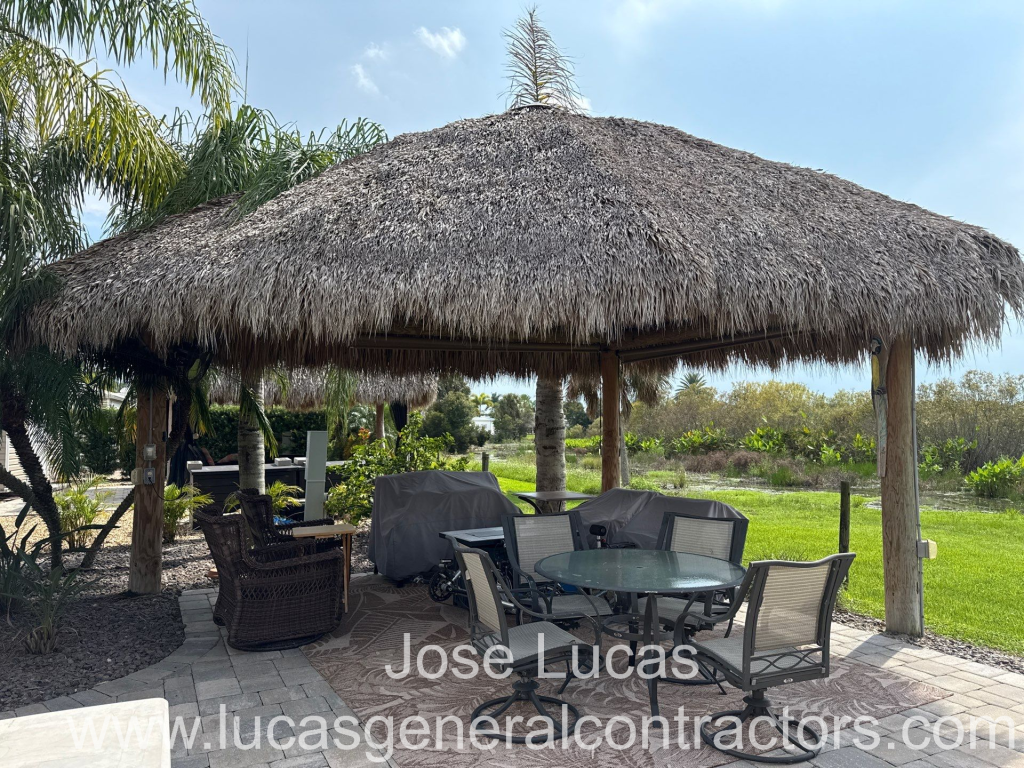
- Aesthetic role: Cypress and natural pine rounds both deliver traditional visual character; performance is driven by exposure, connections, and moisture management.
Why Many Specifications Favor 3×4 PTP Purlins
- Uniform bearing: Flat top/bottom faces with eased edges create a consistent thatch substrate and cleaner fastener engagement.
- Predictable engineering: Known section properties simplify span checks and connector schedules, particularly in higher wind zones.
- Surface quality: Reduced roof “ripple” compared with tapered rounds; improved alignment for curtain ledgers and accessories at the eave.
A) Performance-First Dimensional Package
- Posts: PTP ground-contact (e.g., 8×8–12×12 as engineered)
- Beams/Rafters: Dimensional PTP (rafters commonly 4×6)
- Purlins: PTP 3×4 landscape timbers
- Result: Clean geometry, uniform thatch plane, streamlined detailing and maintenance
B) Traditional Round-Pole Package (Pine or Cypress)
- Posts: PTP ground-contact (decay/termite resistance at the critical interface)
- Beams & Rafters: Natural round pine or cypress for classic appearance
- Purlins (select one):
- PTP 3×4 timbers: Flat, uniform thatch plane; straightforward fastening
- ~3″ natural rounds: Fully traditional aesthetic from eave to ridge
Overhead elements remain drier and function well in either species when correctly sized and detailed.
Post longevity is governed primarily by treatment level, connectors, and moisture control.
Square vs. Round: Functional Differences
- Square assemblies: Posts/beams (8×8–12×12), rafters (often 4×6), purlins (3×4). Advantages include clean accessory mounting (curtain ledgers, lighting, raceways) and precise alignments.
- Round assemblies: Natural taper provides traditional character; minor diameter variation is expected and normal for tree-sourced members.
Connections, Metals & Moisture Management
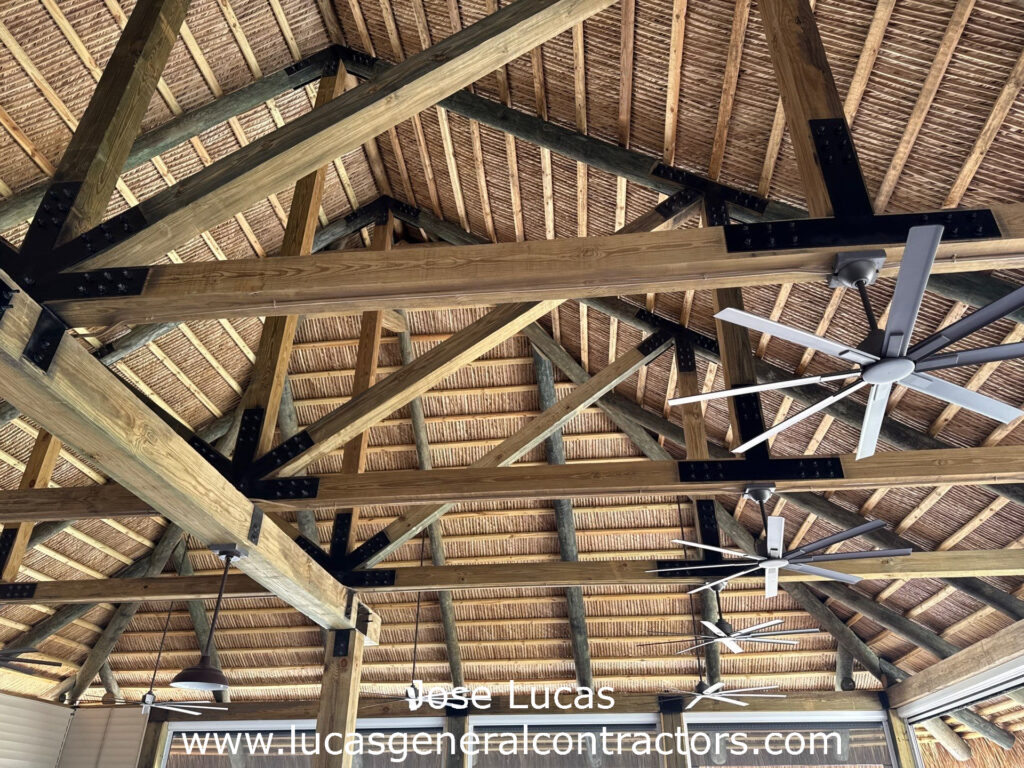
- Connectors: Use hot-dip galvanized or stainless steel with treated lumber; avoid bare carbon steel in coastal exposure.
- Fasteners: Structural screws/bolts; pre-drill near member ends and in dense sections to limit splitting.
- Moisture control: Maintain post-base clearances; manage roof drip with overhangs, diverters, and ridge treatments (crossbars, Polynesian vent caps, or metal ridge caps) suited to wind and water.
Maintenance (Applies to Any Species)
- Rinse salt and organic debris; maintain vegetation setbacks for airflow at bases.
- Inspect connectors and tighten/renew coatings annually.
- Consider synthetic thatch and sealed ridge options where low maintenance is a priority.
Specification Snapshot (Adjust per Project)
-
-
- Posts: PTP, ground-contact; size per engineering and wind exposure
- Beams: Dimensional PTP or natural rounds (pine/cypress), sized by span
- Rafters: Dimensional PTP (e.g., 4×6) or natural rounds
- Purlins: PTP 3×4 (uniform plane) or ~3″ natural rounds (traditional aesthetic)
- Connectors: Hot-dip galvanized / stainless; structural-rated screws/bolts
-
Engineering, Permits & Inspections
Member sizing and connection detailing are not aesthetic choices—they determine safety, durability, and code compliance in every location. Structures built without plans, permits, or inspections often use undersized posts, beams, rafters, and purlins, or skip critical connectors; the result is sag, racking, uplift, leaks, and premature failure.
- Correct sizes & spans: Posts, beams, rafters, and purlins must be sized to tributary area, span, and all governing loads (dead, live, wind, snow, and where applicable seismic).
- Site-specific design values: Use local parameters (basic wind speed, ground snow load, seismic design category, exposure, frost depth, corrosion class) rather than “rule of thumb.”
- Continuous load path: Provide a tie-down path from ridge to base to resist uplift, lateral shear, and overturning—documented in the drawings.
- Connector schedule: Straps, ties, bolts, and structural screws are specified by type, count, and location; use hot-dip galvanized or stainless with treated lumber.
- Bracing & roof rigidity: Knee braces, collar/rafter ties, and ridge details control racking and vibration; purlin spacing creates a stable roof plane for thatch.
- Moisture & durability: Ground-contact treatment where exposure requires; manage drip with overhangs/diverters; compatible metals; breathable ridge options to reduce trapped moisture.
- Permits & stamped drawings: Dimensioned plans with notes and site design criteria form the permit set; inspections verify member sizes, spacing, and hardware as built.
Bottom line: engineered, permitted tiki huts last longer and perform better in all regions—coastal wind, inland snow, high sun/UV, or freeze-thaw. Shortcut builds may look similar on day one, but they do not age the same.
Owner Checklist
- Request the plan set listing member sizes, design loads, and connector types.
- Confirm the project is permitted and will be inspected.
Final member sizes, spans, and connection details should be set by the project’s architect or engineer based on wind zone, exposure, and site conditions. The assemblies above align aesthetics with performance: treated posts at the base, and overhead members—pine or cypress—selected for design intent and proper detailing.